WASA Water Bill Tariff Explained: How Your Bill Is Calculated
Introduction
Water is one of the most important services for every home and business. To provide a continuous water supply and maintain drainage systems, WASA (Water and Sanitation Agency) charges consumers through a monthly billing system. Many people receive their water bills but do not fully understand how the amount is calculated, what charges are included or why the bill changes from one month to another.
Understanding the WASA water bill tariff helps consumers know how their monthly bill amount is prepared. A water bill is not only based on water usage. It may include different components such as water supply charges, sewerage fees, fixed charges, taxes and other applicable fees depending on the connection type and tariff category.
This guide explains the complete WASA water bill calculation method, including meter readings, tariff slabs, domestic and commercial rates and the main parts of a WASA bill in simple words.
What Is WASA Water Bill Tariff?
The WASA water bill tariff is the pricing system used by the Water and Sanitation Agency (WASA) to calculate the amount consumers need to pay for water and related services. The tariff structure determines how much a consumer is charged according to factors such as connection type, water consumption, location, and applicable government rules.
A tariff helps WASA manage water supply operations, repair pipelines, maintain sewerage networks, and provide better services to residents and businesses. WASA is also responsible for the operation and maintenance of water supply, sewerage and drainage systems, as well as billing and collection of applicable charges.
The official WASA tariff page provides information about different tariff categories, including domestic, commercial, industrial and charitable connections.
What Determines the WASA Water Bill?
The final bill amount shown on a WASA bill usually depends on several factors, including:
- Type of connection, such as residential or commercial
- Water consumption during the billing period
- Meter reading details
- Applicable tariff slab
- Fixed and variable charges
- Sewerage and drainage charges
- Taxes or other applicable fees
Consumers can also visit the official WASA billing page for information related to billing services.
For official tariff rates and the latest applicable charges, consumers should always refer to the official WASA Lahore tariff information because rates and government-approved charges may be revised from time to time.
How WASA Water Bill Is Calculated?
Many consumers search for how WASA water bill is calculated because they want to understand why their monthly charges increase or decrease.
The WASA billing system generally calculates the bill by checking the amount of water used during a specific billing period. If the connection has a water meter, the usage is calculated through meter readings.
The basic calculation method is:
Water Consumption = Current Meter Reading – Previous Meter Reading
After finding the total water consumption units, WASA applies the relevant tariff rates according to the consumer category.
The final bill may include:
Total Bill Amount = Water Consumption Charges + Fixed Charges + Sewerage Charges + Taxes + Other Applicable Charges
The exact formula may vary according to the WASA region and approved tariff structure.
Understanding WASA Water Bill Calculation Formula
The WASA water bill calculation formula is based on different billing components rather than a single charge.
A simple example:
Bill Component | Meaning |
Water Consumption Charges | Cost based on the amount of water used |
Fixed Charges | Regular monthly service charges |
Water Supply Fee | Charges for providing water service |
Sewerage Charges | Cost for drainage and wastewater services |
Taxes and Fees | Government or regulatory charges |
For example, if a household uses more water than the allowed limit of a tariff slab, the additional consumption may be charged at a different rate.
This system encourages responsible water usage and helps manage water resources.
WASA Bill Reading Explained: Meter Reading and Consumption
One of the most important parts of the WASA billing process is the water meter reading.
A water meter records the amount of water consumed by a property during the billing cycle. The bill usually contains:
- Previous meter reading
- Current meter reading
- Total consumption units
- Billing period
- Applied tariff
- Total payable amount
Example:
Previous meter reading: 1,250 units
Current meter reading: 1,290 units
Water consumption:
1,290 – 1,250 = 40 units
These 40 consumption units are then calculated according to the applicable WASA tariff rates.
If the meter reading is incorrect or seems unusual, consumers should contact WASA customer support for verification.
WASA Water Tariff Rates and Slab System
WASA uses tariff slabs to calculate water charges. A tariff slab means different water usage levels have different pricing rules.
The purpose of a slab system is to charge fairly. Consumers who use less water usually remain in lower usage categories, while higher consumption may fall into higher slabs.
The applicable tariff can depend on:
- Domestic or residential connection
- Commercial connection
- Amount of water consumption
- Approved WASA tariff rates
A typical tariff structure may include:
Tariff Category | Description |
Domestic Tariff | Applies to homes and residential users |
Commercial Tariff | Applies to shops, offices, and businesses |
Industrial Tariff | Applies to industrial consumers where available |
Special Categories | Depends on WASA rules and local policies |
Because WASA operates in different cities, tariff rates may vary according to local government approval.
WASA Domestic Water Bill Tariff
A WASA domestic water bill is issued to residential consumers who use water for household needs.
Domestic consumers usually pay charges based on:
- Residential connection type
- Water consumption
- Monthly billing cycle
- Applicable domestic tariff rates
Household water usage may include:
- Drinking water
- Cooking
- Washing
- Cleaning
- Other daily activities
Consumers can reduce their monthly water bill by avoiding unnecessary water waste and checking for leaks in pipes, taps and storage tanks.
WASA Commercial Water Bill Tariff
A WASA commercial water bill applies to businesses and commercial properties.
Commercial users often have different tariff rates because their water consumption may be higher compared to normal households.
Examples of commercial users include:
- Offices
- Shops
- Restaurants
- Schools
- Other business facilities
Commercial billing may include higher water consumption charges depending on the connection category and applicable tariff slab.
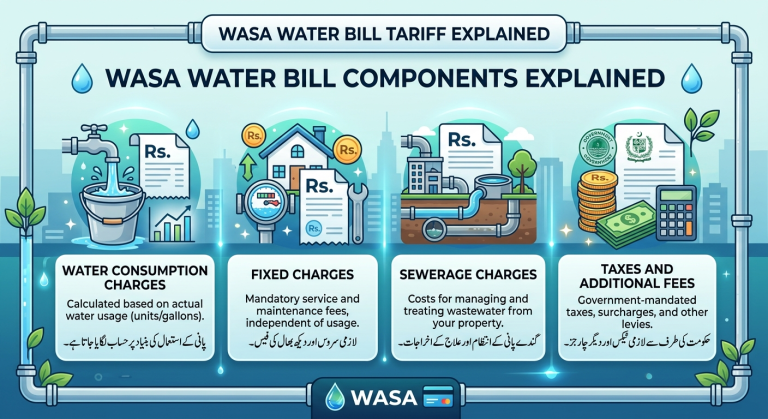
WASA Water Bill Components Explained
Many people only check the final amount on their bill and ignore the detailed breakdown. Understanding the different parts helps consumers identify how charges are added.
1. Water Consumption Charges
These charges are based on actual water usage during the billing period. Higher consumption generally results in higher charges.
2. Fixed Charges
Fixed charges are regular charges applied for maintaining the water supply connection and service availability.
These charges may apply even when water consumption is low.
3. Sewerage Charges
WASA also manages drainage and wastewater systems. Therefore, WASA sewerage charges may be included in the bill.
These charges help maintain:
- Sewer lines
- Drainage systems
- Wastewater management services
4. Taxes and Additional Fees
Some bills may include government taxes or other applicable charges according to official rules.
Factors That Affect Your Monthly WASA Water Bill
Several factors can change your monthly water bill amount.
1. Water Consumption
The biggest factor is how much water is used during the billing period.
More water usage usually means higher consumption charges.
2. Billing Period
The number of days included in a billing cycle can affect the bill amount.
3. Meter Accuracy
A faulty or damaged meter can affect recorded water usage.
4. Connection Type
Domestic and commercial connections usually have different tariff categories.
5. Updated Tariff Rates
If WASA updates its pricing structure, the bill amount may change even with similar water consumption.
How to Check WASA Bill Breakdown Online
Consumers can check their WASA bill details online through official WASA services or bill inquiry platforms.
A bill breakdown usually helps you understand:
- Consumer account information
- Billing month
- Meter reading details
- Water consumption units
- Applied charges
- Due date
- Total payable amount
Checking your bill regularly helps identify unusual increases and keeps your payments updated.
Difference Between Water Usage Charges and Fixed Charges
Many consumers confuse these two charges.
Charge Type | Meaning |
Water Usage Charges | Based on actual water consumption |
Fixed Charges | Monthly service-related charges |
Water usage charges can change every month depending on consumption, while fixed charges usually remain stable according to the approved tariff structure.
Why Does My WASA Water Bill Increase?
A higher WASA bill can happen because of several reasons:
- Increased water consumption
- Leakage in pipes or taps
- Change in tariff rates
- Higher sewerage charges
- Incorrect meter reading
- Additional applicable fees
Checking the bill breakdown can help identify the reason behind an increased amount.
Tips to Reduce Your WASA Water Bill
Saving water can also help reduce monthly charges.
Some useful tips include:
- Repair leaking taps quickly
- Avoid unnecessary water wastage
- Check water tank overflow problems
- Use water carefully during cleaning
- Monitor your monthly consumption
Small changes in daily habits can reduce water usage and help manage your monthly bill.
FAQs
WASA water bill calculation is usually based on water consumption, meter readings, applicable tariff rates, fixed charges, sewerage charges and other fees.
WASA water charges are the fees consumers pay for water supply services. They may include consumption charges, fixed charges and other service-related fees.
You can check your WASA bill amount through online bill checking services by entering your WASA account information or consumer details.
WASA sewerage charges are fees collected for maintaining drainage and wastewater management services.
Your bill can change because of different water usage, meter readings, billing periods, tariff updates or additional charges.