How to Get a New WASA Connection
Getting a legal water connection is an important step when you build, buy or rent a property. The process may look difficult at first but it becomes easy when you prepare the right papers and follow the correct order.
To get a WASA new connection, first confirm that your property is inside the service area of your city WASA. Then choose the correct connection type, complete the application form, attach the required documents and submit the case online or at the relevant office. WASA will inspect the site, prepare an estimate, issue a demand notice or challan and approve installation after payment.
The exact documents, charges and processing time can change from one city to another. Lahore, Rawalpindi, Faisalabad, Multan, Gujranwala and other cities may use similar steps but they do not always use the same form or fee schedule. Always check the official portal or office for your city before paying any amount.
What Is a WASA New Connection?
A WASA new connection is the first legal registration of a property with the Water and Sanitation Agency. It may cover water supply, sewerage or both services.
A legal connection gives the property a consumer number or account number. This number is later used for billing, complaints, payment records and a WASA bill online check. It also helps the agency identify the property and the approved service category.
Never connect a private pipe to a public water line without written approval. WASA Lahore warns that an unauthorized connection can lead to legal action and penalty charges. It also advises consumers not to hand cash to field staff for bill or meter work.
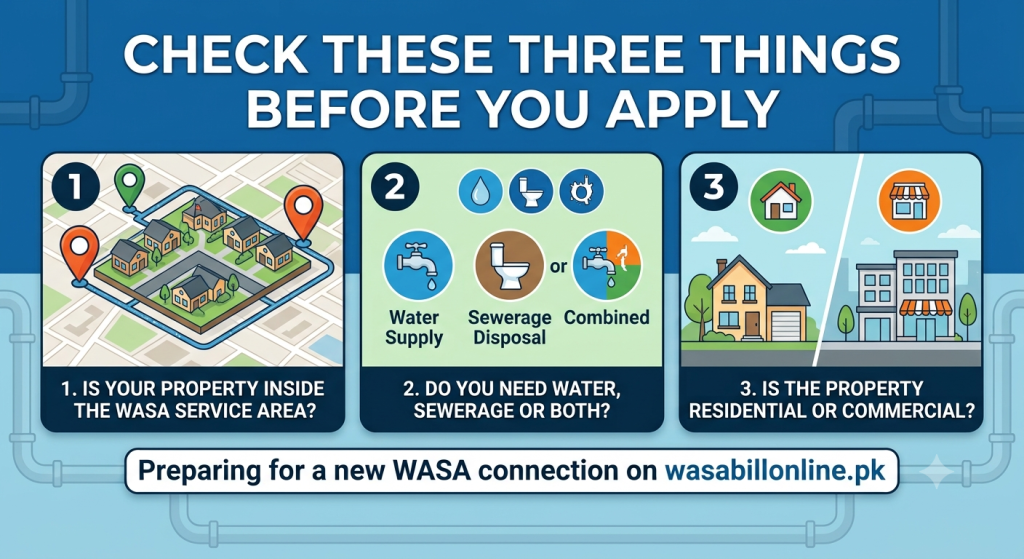
Check These Three Things Before You Apply
Before filling out the WASA new connection application form, check the following points.
1. Is Your Property Inside the WASA Service Area?
A connection can only be approved where WASA has authority and a working network. A nearby water line does not always mean that your property can be connected.
The line may be too far away, too small, damaged or reserved for another service area. Ask the local office to confirm jurisdiction and technical feasibility. This simple check can save time and prevent unnecessary document and drawing costs.
2. Do You Need Water, Sewerage or Both?
Some forms allow you to request water and sewerage together. In other places, you may need a separate WASA sewerage connection application. Select the service that is actually available at your property.
A water connection brings water to the premises. A sewerage connection carries wastewater from the property to the public sewer. One service does not always confirm that the other service is available.
3. Is the Property Residential or Commercial?
Select the correct category from the start. A house used only by a family is normally residential or domestic.
Shops, offices, restaurants, schools, workshops, plazas and other business properties may fall under commercial, industrial, construction or charitable categories.
Using a residential connection for business activity may lead to a tariff change, extra charges or a notice from the revenue office.
Property Documents Required for WASA Connection
The final checklist depends on the city and the property. The table below covers the documents most commonly requested by official WASA offices.
Document | Why WASA May Need It |
Copy of CNIC | Confirms the identity of the applicant |
Sale deed, registry, allotment letter or other ownership proof | Confirms the legal link between the applicant and property |
Site plan or location sketch | Helps the field team find the property and nearby service line |
Recent utility bill | Supports address verification |
Neighbor’s WASA bill, where requested | Helps identify the local billing area and nearby account |
Property tax assessment or Excise and Taxation record, where required | Supports property classification and location details |
Tenancy agreement | Needed when the applicant is a tenant |
Written consent from the owner | Gives the tenant permission to request the service |
Old paid water or sewer bills, if a service was already used | Helps check past records and unpaid dues |
Commercial approval or NOC, where required | Supports a commercial, converted or special-use property |
Applicant mobile number and address | Used for contact, updates and record creation |
GPS location or map pin, on some online forms | Helps the inspection team find the exact site |
Official Lahore information lists CNIC, proof of ownership, a utility bill and an optional neighbor WASA bill. Gujranwala also lists CNIC, ownership proof, property assessment and a site plan.
The Gujranwala online form says a tenant must provide a tenancy agreement and the owner’s written consent.
Take clear copies and keep the original documents with you during an office visit. Names and addresses should match across the form, CNIC, ownership papers and utility bill.
A small spelling or property-number difference can delay verification.
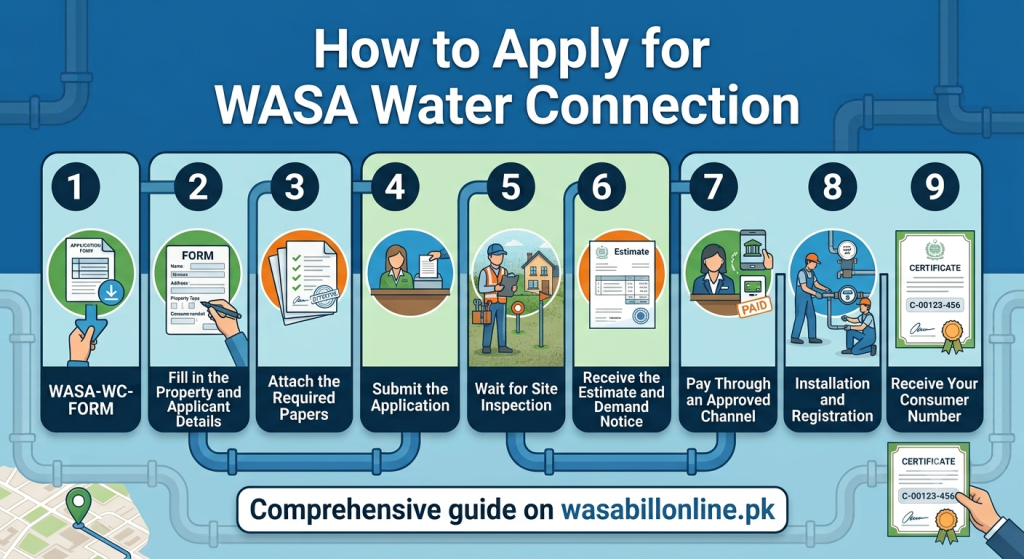
How to Apply for WASA Water Connection
The exact WASA new connection procedure can differ by city but the main water supply line connection steps are usually similar.
Gujranwala’s official process, for example, moves the file through site verification, revenue data entry, challan issuance, payment, installation and billing.
Step 1: Get the Correct Application Form
Download the form from your city’s official website, use the official online portal, apply through the Punjab WASA app where supported or collect the form from the local WASA customer service or Sub Divisional Office.
Do not use an old form from an unknown website. Forms, categories and document requirements can change.
Step 2: Fill in the Property and Applicant Details
Enter the applicant’s full name, CNIC number, mobile number, postal address, property address, plot size, number of floors, service category and type of connection.
Write the information exactly as it appears on your documents. Do not leave important fields blank. If a field does not apply to your property, ask the receiving office what to enter.
Step 3: Attach the Required Papers
Arrange the papers in the same order as the official checklist. Use clear PDF scans for an online submission.
Some portals set a file-size limit, so scan the papers in readable quality without making the file too large.
For a rented property, attach the tenancy agreement and owner permission. For joint ownership, the office may ask for consent or an affidavit from the other owner or owners.
Step 4: Submit the Application
You may submit the WASA new connection form through an official online system or at the local office named by your city WASA.
In many traditional office processes, the Sub Divisional Officer and Revenue Division handle the application.
Keep the application number, receipt, tracking number or stamped copy. It is your proof that the case was submitted.
Step 5: Wait for Site Inspection
A WASA field worker or technical officer will visit the property. The officer may check the exact property location, distance from the public line, size and condition of the pipe, road-cutting needs, existing service, unpaid dues and property category.
The inspection is not only a formality. WASA can delay or refuse the case when the public line is unavailable or the connection is not technically safe.
Step 6: Receive the Estimate and Demand Notice
After verification, the revenue or technical office prepares the WASA connection estimate fees calculation.
The applicant then receives a demand notice, security challan or payment voucher.
Read the challan carefully. Check the applicant name, property address, service type, category and amount before payment.
Step 7: Pay Through an Approved Channel
Pay only through the bank, payment service, portal or official counter named on the challan. Keep the original receipt and a clear photo or copy.
Do not give cash to a worker who visits the property. Official WASA safety guidance tells consumers to avoid direct cash payments to staff.
Step 8: Installation and Registration
After payment confirmation, WASA issues the installation order. The approved team connects the property to the public line and records the installation date.
For a metered connection, the meter number, size, reading and installation details should be entered in the official record. This is the new water supply meter registration stage.
Check that the meter is placed where it can be inspected and read without difficulty.
Step 9: Receive Your Consumer Number
After computerization, the property receives a consumer number, account number or registration number.
Save this number in more than one place. You will need it for billing, online services, complaints and future record changes.
Can You Apply for a WASA Connection Online?
Yes, the WASA new connection procedure online is available in some cities but it is not the same everywhere.
Lahore provides an official online route for a new water and sewer connection. Gujranwala has an official web form that asks for personal details, property information, category, plot area, GPS location and a PDF attachment.
The Punjab WASA app also supports new water or sewer applications and status tracking. Lahore e-Khidmat Markaz has also offered residential and commercial new water connection services.
Even when you apply online, a site inspection and physical installation are still required. An online form starts the case. It does not remove technical verification, payment, or field work.
When the online option is not available, submit the form at your area’s customer service center, Sub Divisional Office, Revenue Office or another location named on the city website.
Where to Submit the WASA New Connection Form
The correct place depends on your city.
First, check the official WASA website for your area. Look for pages named New Connection, Consumer Services, Customer Care or Revenue Office.
Use the official application portal or Punjab WASA app where supported. When online submission is unavailable, visit the local Sub Divisional Office, Revenue Office or customer service center.
In Lahore, applicants can also check whether the nearest e-Khidmat Markaz currently accepts residential or commercial water connection applications.
Do not submit property papers or CNIC copies through an unofficial agent or unknown social media number.
WASA Connection Charges and Fees
There is no single fixed price for every WASA new connection in Pakistan.
The cost can change by city, connection category, plot size, pipe size, service type, road condition and distance from the main line.
A connection estimate may include the following charges:
Cost Part | What It Covers |
Application or processing fee | Opening and checking the case |
Security deposit | Security held under the local tariff rules |
Water or sewer connection fee | Approval and connection work |
Meter cost | Meter and related parts, where metering applies |
Pipe and fitting cost | Material used from the public line to the approved point |
Excavation or road-cutting cost | Digging and restoring the street or road |
Labor or installation cost | Work done at the site |
Advance billing amount | An amount later adjusted in bills, where the city uses this system |
Old dues | Unpaid charges already linked to the property |
Commercial, infrastructure or NOC charges | Extra charges for certain property uses or projects |
The Gujranwala process states that a security challan is issued after verification. It also says an estimated six-month advance bill may be included and later adjusted in monthly bills.
Its online terms say that site costs such as excavation and sewer line installation may be paid by the applicant.
For this reason, do not trust a random online figure for the total price. The only reliable amount is the current official estimate issued after your property is checked.
How Long Does It Take to Get a WASA Water Meter?
A WASA new connection may take a few working days or several weeks.
The time depends on document checking, inspection, line availability, payment, road permission, office workload and material availability.
Some official city guidance gives a standard target. For example, WASA Okara states a normal processing time of 15 to 20 working days for a complete application.
Gujranwala states that processing time can vary with technical requirements and document completion.
Use 10 to 20 working days only as a planning range, not a promise. Ask for a written status when the expected time has passed.
Residential vs Commercial WASA Connection
Point | Residential Connection | Commercial Connection |
Main use | Family home and normal household use | Shop, office, restaurant, school, workshop, plaza or business |
Tariff | Usually lower | Usually higher |
Documents | Basic ownership and identity papers | May need business, land-use, building or NOC papers |
Inspection | Checks home use and line feasibility | Checks business use, water demand, drainage and category |
Meter or pipe size | Based on domestic needs | May be larger based on demand |
Future change | Must be updated if property use changes | Must remain in the approved business category |
A residential WASA new connection is only for approved household use. Do not choose the residential category just to reduce the initial cost.
A wrong category can create billing disputes, tariff changes and extra charges later.
WASA Sewerage Connection Application
A sewerage connection is important even when the property receives water from another source. It gives wastewater a legal route into the public sewer system.
The office may inspect the sewer level, pipe route, connection point and distance from the main sewer. If the level is not suitable, the applicant may need technical changes before approval.
Do not send rainwater, solid waste, oil, chemicals, construction waste or other harmful material into the sewer.
Commercial and industrial properties may face added rules because their wastewater can damage the public system.
Where the form offers both services, select water and sewerage carefully. Where separate forms are used, submit the correct application for each service.
When Is a WASA NOC Needed?
A WASA NOC application process is not part of every normal house connection.
It is more common for commercial properties, converted plots, building approvals, housing schemes or projects that may affect water, sewerage or drainage infrastructure.
The NOC office may ask for ownership papers, approved building or site plans, land-use approval, project details, calculations, previous clearances and payment of applicable charges.
Lahore publishes separate document guidance for commercial properties and housing schemes.
Ask the relevant planning, building or commercial authority whether your case needs a WASA NOC before submitting the connection file. Getting this answer early can prevent rejection.
How to Track WASA New Connection Status
Keep the application reference after submission.
Depending on the city, you may be able to track the case through the Punjab WASA app, an online portal, a customer service center or the Revenue Office.
A normal WASA new connection tracking status may pass through these stages:
Application received, document review, site inspection, feasibility approved, estimate prepared, challan issued, payment verified, installation ordered, connection installed and account activated.
When you contact WASA customer service for a new connection, provide the application number, applicant CNIC, mobile number and property address.
Ask which stage is pending and whether any document or payment is missing.
What Happens After the Connection Is Installed?
Once the WASA new connection is installed, do not assume that billing is fully active.
Confirm that the account has been entered into the billing system and that you have received a consumer, account or registration number.
When the first bill is created, check these details:
- Consumer name
- Property address
- Residential or commercial category
- Water and sewer services
- Meter number, where applicable
- Opening meter reading
- Billing period
- Previous amount or adjustment
After activation, you can use your account details for a WASA bill online check.
If the printed bill is lost or not delivered, use the official WASA duplicate bill download service for your city.
Gujranwala, for example, allows bill searches by account number or registration number. Rawalpindi asks for an eight-digit consumer code on its official online bill service.
Report a wrong name, address, category, meter number or opening balance as soon as possible. Early correction is easier than fixing several incorrect bills later.
Common Reasons a New Connection Is Delayed
A WASA new connection file often slows down because the documents do not match, the location is unclear, old dues exist or the public line is unavailable.
Other common problems include:
- Incomplete application form
- Unclear document scans
- Missing property-owner consent
- Wrong property category
- Unpaid demand notice
- Missing commercial NOC
- Road-cutting approval issues
- Difficulty contacting the applicant
- Difference between the site plan and actual property
- Lack of suitable water or sewer infrastructure
Before submitting, compare every document with the application form. After submission, answer calls from the official team and keep your payment proof ready.
What to Do If the Application Is Rejected
Ask for the reason in writing or request a clear status note. A rejection may be temporary when a document is missing or a technical problem can be fixed.
Correct the issue and submit the required paper through the official channel.
If the property is outside the network or no safe connection point exists, ask whether a network extension is planned and whether a new estimate or approval may be possible later.
Do not pay an agent who promises approval without inspection. Technical feasibility and legal property checks cannot be safely bypassed.
WASA Complaint and Helpline Number
The short helpline number 1334 is used by several Punjab WASA agencies, including Lahore, Rawalpindi, Multan, Faisalabad and Gujranwala.
Service hours can differ. Lahore lists its central complaint center as available 24 hours, while Rawalpindi lists 1334 from 8:00 am to 11:00 pm.
Use the helpline for status guidance, water supply problems, sewer overflow, leakage, billing issues and complaint registration.
For a new connection case, keep the application or consumer number ready.
You should still confirm the city-specific phone number and office hours on the official website because local contact details can change.
Practical Example From an Official WASA Process
The Gujranwala process shows how a complete file can move through different offices.
The applicant submits the form. The Sub Divisional Officer checks the site and arrears record.
The case then goes to the Revenue Division for data entry and issuance of a demand notice or security challan. After payment, the Sub Divisional Officer orders installation.
The installation date and payment record are then sent for billing.
This example explains why a new connection is not completed by one desk. Technical inspection, revenue checking, payment, installation and billing activation are separate parts of the same case.
Simple Tips That Can Save Time
Prepare one paper file and one digital folder before applying. Keep clear scans of the CNIC, ownership papers, site plan, utility bill and signed form.
Write the same mobile number on every page where it is requested. Save the application number, challan, receipt, meter photo and first bill.
Visit or call only after you can clearly state the pending stage.
Saying that the connection is late is less useful than asking whether the site report, estimate, payment verification or installation order is pending.
Final Checklist
Before submitting your WASA new connection request, make sure the form is complete, the property category is correct, all document copies are clear, names and addresses match, tenant permission is attached where needed and the mobile number is active.
After submission, keep the reference number. After payment, keep the challan receipt. After installation, record the meter details and confirm billing activation.
The safest approach is simple. Use the official form, pay only through approved channels, keep every receipt and verify city-specific requirements before visiting the office.
This protects your money and helps the application move without avoidable delay.
Information Note
WASA rules, tariffs, online services, office hours and document lists can change by city.
This guide explains the common process and uses current official examples from Punjab WASA agencies. Check the official website, Punjab WASA app, e-Khidmat service or local office before applying or paying.
FAQs
What documents are needed for a WASA new connection?
Most applicants need a CNIC copy, property ownership proof, location or site plan and a utility bill.
Is a water meter always installed?
It depends on the city, service area, connection category and current metering policy.
Where a meter is required, confirm that its number and opening reading are recorded correctly.
Can I get a connection if old bills are unpaid?
WASA may check arrears linked to the property before approval.
Clear or resolve old dues through the Revenue Office before expecting final installation.
How can I register a new water line in Pakistan?
Find the water and sanitation authority for your city, confirm its jurisdiction, submit the official form and property papers, complete the site inspection, pay the official estimate, and wait for approved installation and account activation.
Can a tenant apply for the connection?
A tenant may apply where local rules allow it, but the office can require a valid tenancy agreement and written consent from the property owner.